A couple who signs a venue rental contract in January discovers six months later that the caterer requires a minimum of eighty guests, while their guest list includes only sixty.
This mismatch between the chosen venue and the actual size of the wedding can lead to extra costs that most inspiration guides don’t cover. Planning a wedding day that works means settling a few practical decisions before thinking about decorations or entertainment.
Minimum guest counts and hidden packages: the true cost of a reception venue
The reception venue often accounts for the largest share of the wedding budget. Couples compare rental rates, visit three or four venues, and negotiate. The sticking point is usually the additional terms and conditions.
Many venues and caterers apply a minimum package fee or minimum guest count. Cutting the guest list doesn’t always reduce the bill proportionally: fixed costs (rental, staff, logistics) remain the same. For an intimate wedding with forty guests, the cost per person can be twice as high as for a wedding with 120 guests at the same venue.
Before signing, always ask for a breakdown of fixed and variable costs. It’s the only reliable way to compare quotes. A beautiful venue with a high minimum spend can end up costing more than a less spectacular space with no minimum requirement. On blog-mariage.net, accounts from couples who negotiated these terms offer a practical sense of what’s possible.
Off-site civil ceremonies: what the law actually allows
The idea of an outdoor ceremony in a garden or by the sea is a dream for many couples. In France, the legal reality is more restrictive. A civil ceremony must take place in a municipal building, unless a narrowly defined exception applies (for example, if one of the spouses is unable to travel).
This is governed by the Civil Code and public service guidelines. The mayor may officiate the marriage in an annex to the town hall, provided it is located within the municipality and open to the public. A private barn or vineyard estate does not qualify, even with the mayor’s approval.
Many couples confuse a civil ceremony with a symbolic ceremony. The former is legally binding and must take place at the town hall (or an annex). The latter is a symbolic celebration with no legal standing, and can be held anywhere in any format. Planning both on the same day requires careful timing between the town hall and the reception venue, especially if the two locations are far apart.
Wedding budget: compare the cost per guest, not the total
Published estimates of overall wedding budgets often vary threefold depending on the source. The reason is simple: surveys don’t measure the same thing. A survey of French people’s spending intentions doesn’t reflect actual expenses after the wedding.
A more reliable approach is to calculate the cost per guest rather than the total budget. This shows that weddings with fewer guests aren’t necessarily cheaper: fixed costs (photographer, DJ, florist, officiant) are spread across fewer people.
Costs that don’t change with the number of guests
- Photographers and videographers charge by the day, not by the number of guests. Their fee is the same for thirty or 150 people.
- Venue rental often includes a base fee that doesn’t depend on the number of guests, covering use of the space and furniture.
- Floral decorations for shared spaces (ceremony arch, buffet centerpiece, entrance) are a fixed cost; only individual table arrangements vary.
- DJs and bands charge by the hour, regardless of the size of the gathering.
Listing these fixed costs in advance helps you work out how many guests you need for the cost per person to feel reasonable. It’s a decision every couple should make before settling on the wedding format.

Entertainment and atmosphere: three choices that can transform the evening
Lists of fifty wedding entertainment ideas are everywhere. In practice, what makes the difference between a great evening and a drawn-out series of activities is the pacing, not the quantity. Two or three well-timed activities are better than ten that overlap.
Schedule activities during lulls
The drinks reception and the wait between courses are the two moments when energy tends to dip. That’s when a short activity works well: a guessing game about the couple during the cocktail hour, or a photo booth guests can use between courses. Scheduling an activity during dessert or the bouquet toss creates competition for guests’ attention and detracts from both moments.
Choose a format that suits your guests
A themed escape game works well with a group of people in their thirties. For a multigenerational gathering, choose activities everyone can enjoy: a music quiz, an audio guest book, or a video montage of messages recorded in advance by friends and family.
The simplest test: if an activity takes more than two minutes to explain, you risk losing half the room. The activities that work best are those guests can understand just by watching others take part.
Wedding theme and decorations: start with what’s already there
Choosing a theme doesn’t mean starting from scratch. Couples who achieve the most cohesive look start with the venue and the season, rather than a Pinterest mood board disconnected from reality.
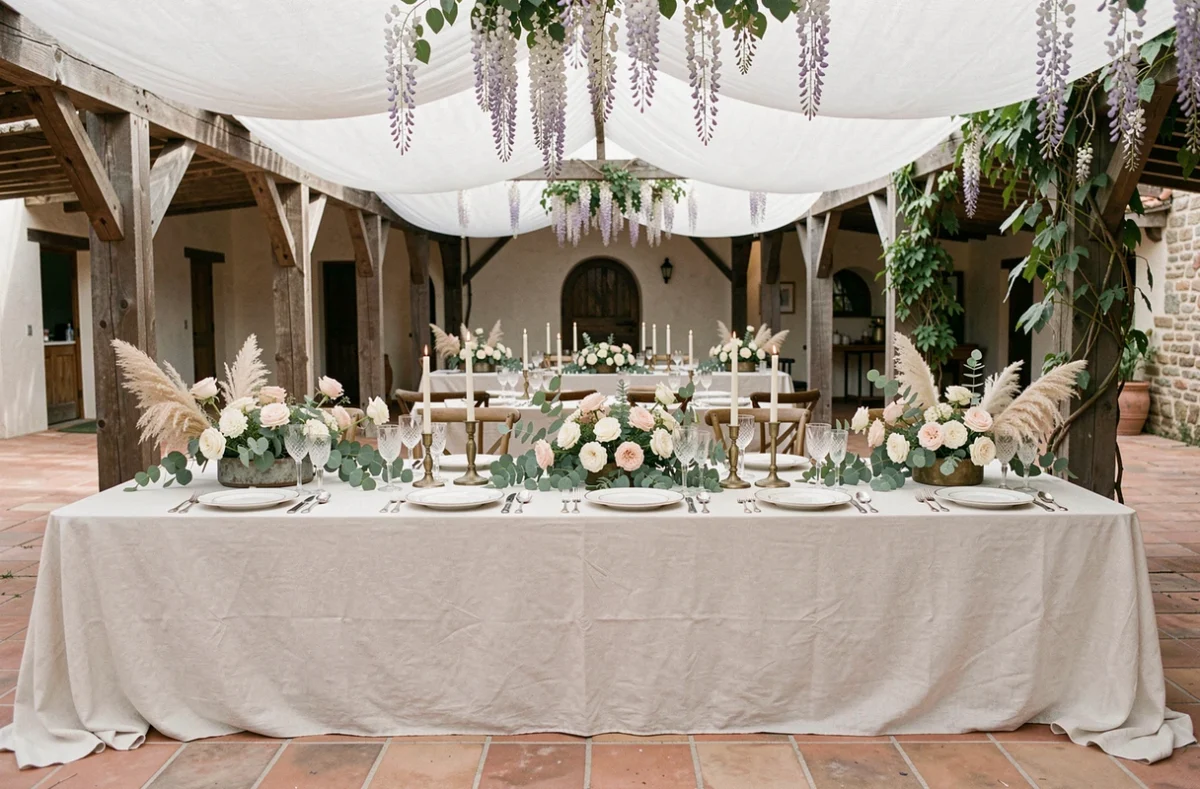
A venue with stone walls and exposed beams naturally lends itself to warm colors and raw materials. Imposing a tropical theme on this setting takes considerable decorative effort (and budget) and often looks artificial. By contrast, making use of the venue’s existing features reduces decoration costs and creates a more natural atmosphere.
- Identify architectural features that can serve as a backdrop without any additions (a staircase, glass roof, or centuries-old tree).
- Choose a color palette that complements the space’s dominant tones.
- Focus the floral budget on two or three focal points (the head table, arch, entrance) rather than spreading it everywhere.
Decorators who visit the venue before preparing a quote can offer more tailored recommendations than those who work from photos alone. Scheduling a site visit during the planning process helps avoid unpleasant surprises on the big day.
A successful wedding isn’t measured by the number of original ideas piled on, but by how well the venue, format, budget, and guest count work together. Settling these four factors early in the planning process frees up mental space for the fun choices: the music, the menu, and the details that make the day unique.