
The Black Decker CD601 circular saw remains a model that is regularly encountered on marketplaces and in DIY workshops, even though the manufacturer no longer lists it in its online catalog. This discrepancy between its persistent presence in the second-hand market and its absence from current ranges raises a simple question: what is this machine really worth against today’s cutting standards?
Black Decker CD601 and catalog obsolescence: what the manufacturer’s website disappearance signals
Black+Decker has removed the CD601 from its official catalog for several years. This withdrawal is not trivial. It indicates that the manufacturer has shifted its production towards models incorporating regulatory and technical developments that emerged after the design of the CD601.
Recent circular saws from the brand generally offer an improved motor brake, better compatibility with dust extraction systems, and stiffer bases. The CD601 has not benefited from these updates.
However, its enduring presence in the second-hand market and among third-party retailers (Cdiscount, Amazon, Cash Converters) suggests an acceptable failure rate as judged by users. A tool that is still circulating after several years on the market without a massive recall indicates a basic mechanical robustness suitable for DIY use. It is possible to learn more about the Black Decker CD601 to check for still active points of sale and compatible accessories.
Power and cutting depth: the numbers against real needs
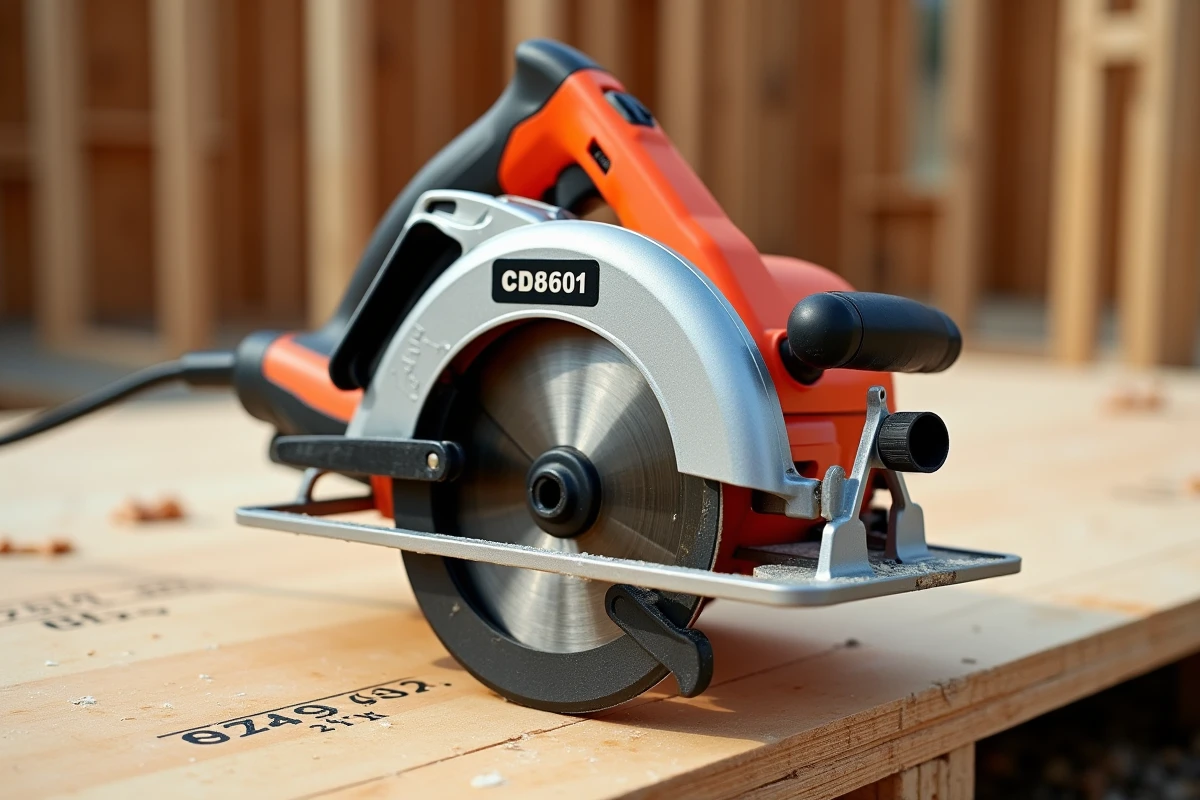
The technical sheet of the CD601 displays 1100 W of power and a no-load speed of 5000 revolutions per minute. The cutting depth reaches 55 mm at 90°, with a blade of 170 mm in diameter.
These values place the machine in the segment of circular saws intended for common work on softwood and derived panels. For plywood, paneling, or fir boards, the motor’s power is sufficient to maintain a stable speed.
Limits appear with hard woods or repeated thick cuts. A solid oak of 50 mm pushes the motor to its maximum capacity, which can lead to a noticeable drop in speed and a less clean cut finish. Field feedback varies on this point: some users report satisfactory cuts in beech, while others find excessive effort as soon as the thickness exceeds 40 mm in hard wood.
The 170 mm blade, a size that limits options
The 170 mm blade diameter restricts the choice of replacement blades compared to the more common 190 mm size found in Bosch or Makita. Finding a quality carbide blade in 170 mm is still possible, but the catalog is less extensive.
This size also imposes a maximum cutting depth of 55 mm. For light framing work or cuts in thicker wood, one would need to switch to a higher caliber model.
Safety and ergonomics of the CD601 compared to current circular saws
This is where the gap with recent models becomes most evident. Circular saws marketed since the early 2020s come standard with several features that the CD601 lacks:
- A quick motor brake that stops the blade within seconds after releasing the trigger, reducing the risk of accidental contact
- An optimized dust extraction connection to capture fine dust directly at the source, a significant comfort and health factor during prolonged cuts
- Stiffer cast aluminum bases that limit flexing and improve precision along the entire cutting length
- Cutting lines with LED lighting or integrated laser guides, making it easier to follow the line in poor lighting conditions
The CD601 features a cutting depth adjustment described as easy by the manufacturer, and a protective guard compliant with the standards of its design era. The absence of a motor brake is the most notable safety weakness compared to current standards.
Ergonomically, the weight and balance of the machine remain adequate for occasional cutting sessions. Regular users will note the absence of a soft grip on the main handle, a comfort detail that has become common on competing models.

Price and value for money: buying a CD601 second-hand or new today
The indicative retail price of the CD601 is around 96 to 100 euros including VAT at online retailers still offering it new. This price places it in the same range as more recent circular saws equipped with motor brakes and improved dust extraction.
This is where the calculation becomes unfavorable for the new CD601. For a similar budget, current models from Black+Decker or competing brands offer superior safety and ergonomics features. The new purchase of the CD601 is no longer justified at the current catalog price.
The second-hand market changes the game
In the second-hand market, the CD601 is traded at a significantly lower price. At this reduced price, the offer becomes coherent for an occasional DIYer looking for a reliable circular saw for simple cuts in softwood, without particular requirements for motor brake or integrated dust extraction.
Before buying second-hand, three points deserve verification: the condition of the motor brushes, any play in the base, and the wear of the original blade. A tool with long brushes and a base that shows no abnormal flexing still has several years of service ahead for domestic use.
The Black Decker CD601 remains a functional tool for basic cuts in wood, with mechanical durability evidenced by its longevity in the secondary market. Its lack of motor brake and limitations in cutting depth place it at a disadvantage compared to circular saws sold at the same price today. In the second-hand market, at a reduced price, it retains relevance for occasional work without high finishing demands.